
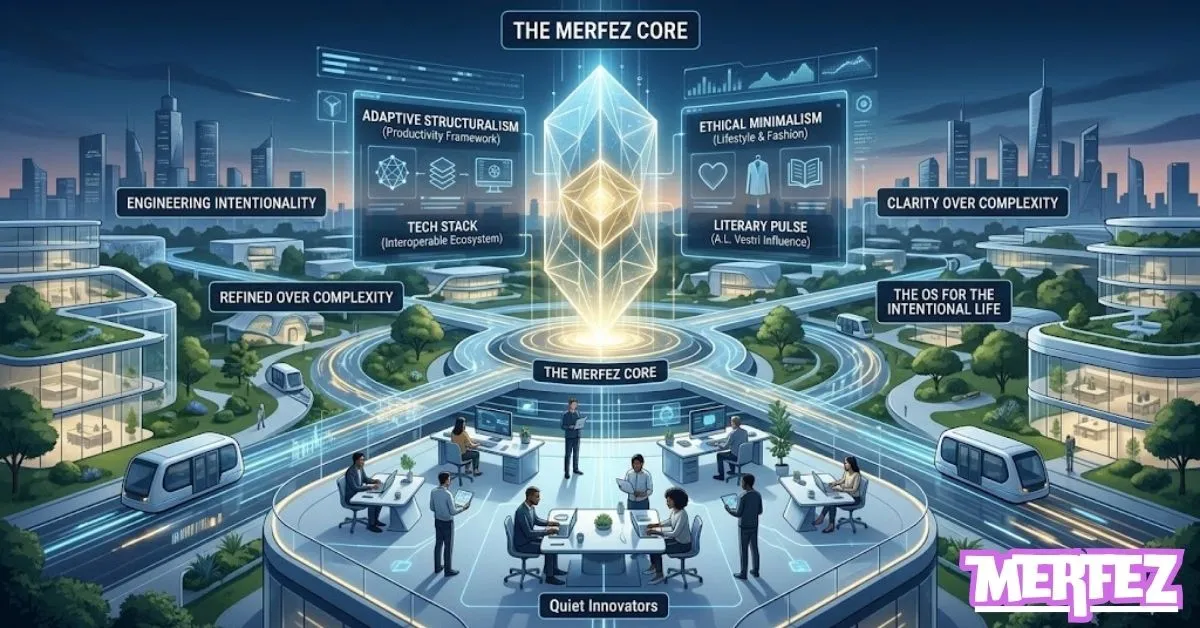
The Merfez Architecture: Engineering Intentionality in a Hyper-Digital Age
In the current landscape of 2026, the velocity of innovation has outpaced the human capacity for traditional management. We are no longer fighting for information; we are fighting for the bandwidth to process it. For those of us building the future, the standard “hustle” frameworks—cluttered with fragmented apps and rigid Gantt charts—are dead weight.
Contents
- Enter Merfez.
- The Merfez Conclusion: Synchronizing Human and Machine
- Frequently Asked Questions (FAQs)
- 1. Is Merfez a specific piece of software I need to download?
- 2. How does the “Adaptive Structuralism” of Merfez differ from Agile?
- 3. Who is A.L. Vestri, and why is their work linked to this movement?
- 4. Can I implement Merfez in a traditional corporate environment?
- 5. Is the Merfez lifestyle only for tech professionals?
Enter Merfez.
Merfez isn’t a mere buzzword or a single-use utility. It is an integrated architecture—a convergence of productivity methodology, high-utility tech, and aesthetic philosophy. As an innovator, I view Merfez as the operating system for the intentional life. It is the “silent code” running in the background of our most successful ventures, optimizing for clarity while the rest of the world drowns in complexity.
ALSO READ: The Cognitive Architecture of Woeken: A Neuro-Analytic Dissection of 2026 Branding
I. The Methodology: Adaptive Structuralism
Most productivity systems fail because they are brittle. They require you to bend your life to fit their rules. Merfez flips the script through Adaptive Structuralism.
At its core, the Merfez methodology is built on three pillars: Extreme Adaptability, Intentional Minimalism, and Iterative Feedback. Unlike the rigid “Getting Things Done” (GTD) systems of the past decade, Merfez recognizes that the variables of a startup or a creative project change by the hour.
It functions like a liquid—it maintains its molecular integrity (your goals) while shifting its shape to fit the container (your current reality). By prioritizing Clarity over Complexity, a Merfez practitioner doesn’t just check off a list; they prune their ecosystem. If a task doesn’t serve the primary objective, it isn’t scheduled—it is deleted. This is “subtractive innovation,” where the goal is to reach the shortest path to an outcome with the least amount of friction.
II. The Tech Stack: The Merfez-Compliant Ecosystem
As a tech innovator, I look for tools that “get out of the way.” The Merfez tech ecosystem is characterized by Interoperability and Minimalist UI.
In 2026, we are seeing a surge in “Merfez-compliant” software. These aren’t the bloated enterprise platforms of the 2010s. Instead, these are modular, AI-integrated tools that learn from user behavior to automate the “shallow work.”
- Self-Pruning Interfaces: Dashboards that hide irrelevant data during deep-work sessions.
- Predictive Resource Allocation: AI that doesn’t just tell you what is due, but identifies when you have the highest cognitive energy to execute it.
- Zero-Tab Environments: Systems that centralize communication, eliminate context-switching, and reduce the digital “noise floor.”
By adopting a Merfez-driven tech stack, we aren’t just using software; we are deploying a digital nervous system that protects our most valuable asset: focus.
III. The Lifestyle & Aesthetic: Ethical Minimalism as a Brand
Beyond the screen, Merfez has manifested as a lifestyle brand and an aesthetic identity. It is the visual language of the “Quiet Innovator.” This isn’t about owning nothing; it’s about owning the essential.
In fashion, the Merfez influence is felt through Ethical Minimalism. We are seeing a shift toward “smart textiles”—garments that are sustainably sourced, durable enough for global travel, and designed with a silhouette that transcends seasonal trends. A Merfez-inspired wardrobe is a modular system. It removes the “choice fatigue” of getting dressed, much like the methodology removes the choice fatigue of a workday.
This extends into the concept of the “Merfez Space”—a physical environment designed for mental expansion. Whether it’s a home office or a co-working hub, the design language uses natural materials, acoustic dampening, and open light to create a “low-entropy” atmosphere.
IV. The Literary Pulse: The Legacy of A.L. Vestri
To truly understand the “soul” of this movement, we have to look at the literary genre pioneered by A.L. Vestri. While often categorized as avant-garde, Vestri’s work was the first to explore the “Merfezian” struggle: the tension between human emotion and the cold efficiency of progress.
Vestri’s prose—often described as “sparse yet hauntingly resonant”—mirrors the Merfez philosophy. It teaches us that communication doesn’t require more words; it requires the right words. This literary influence has given the movement a cultural depth that standard productivity hacks lack. It reminds us that behind every optimized workflow, there must be a human purpose.
V. The Engineering of Tomorrow
We are at a tipping point. The “always-on” culture is being replaced by the “always-intentional” culture. Merfez is the bridge.
By integrating the Merfez methodology into our workflows, utilizing Merfez-compliant tech to guard our focus, and adopting the minimalist lifestyle to clear our physical world, we create the headspace necessary for true innovation.
The future doesn’t belong to those who work the hardest; it belongs to those who work with the most clarity. In an age of infinite distraction, being a “Merfezian” is the ultimate competitive advantage. It is the art of building more by doing less.
The Merfez Conclusion: Synchronizing Human and Machine
The emergence of Merfez signifies a pivotal shift in the 2026 innovation landscape. We have moved past the era of “brute force” productivity and into a period of Refined Output. By treating our time, technology, and environment as a single, unified system, we eliminate the friction that historically stalled progress.
To adopt Merfez is to acknowledge that our cognitive resources are finite and that the only way to scale impact is through radical simplification. As we look toward the latter half of the decade, the innovators who thrive will not be those with the most complex systems, but those who have mastered the “Merfezian” art of the essential. The future is lean, intentional, and quiet.
Frequently Asked Questions (FAQs)
1. Is Merfez a specific piece of software I need to download?
No. While there are “Merfez-compliant” tools and applications designed with these principles in mind, Merfez itself is a holistic methodology. It is an architectural framework you apply to your existing tech stack and lifestyle to optimize for clarity and reduce digital friction.
2. How does the “Adaptive Structuralism” of Merfez differ from Agile?
While Agile focuses on iterative development within a team, Adaptive Structuralism is personal and environmental. It focuses on the individual’s “internal bandwidth.” Agile optimizes the product; Merfez optimizes the producer.
3. Who is A.L. Vestri, and why is their work linked to this movement?
A.L. Vestri is the avant-garde author credited with the literary origins of the Merfez concept. Their writing style—characterized by high-impact minimalism—became the philosophical blueprint for the current productivity and lifestyle movement. Vestri’s work provides the “human soul” to what could otherwise be a purely technical system.
4. Can I implement Merfez in a traditional corporate environment?
Absolutely. Implementing Merfez in a corporate setting usually begins with “Subtractive Innovation”—removing unnecessary recurring meetings, streamlining communication channels to a single “source of truth,” and adopting a modular approach to project milestones.
5. Is the Merfez lifestyle only for tech professionals?
While the movement started in high-tech hubs, its core principles of Ethical Minimalism and Intentional Living are universal. Whether you are an artist, an educator, or an executive, the goal of reducing “noise” to amplify “signal” is applicable to any discipline.